
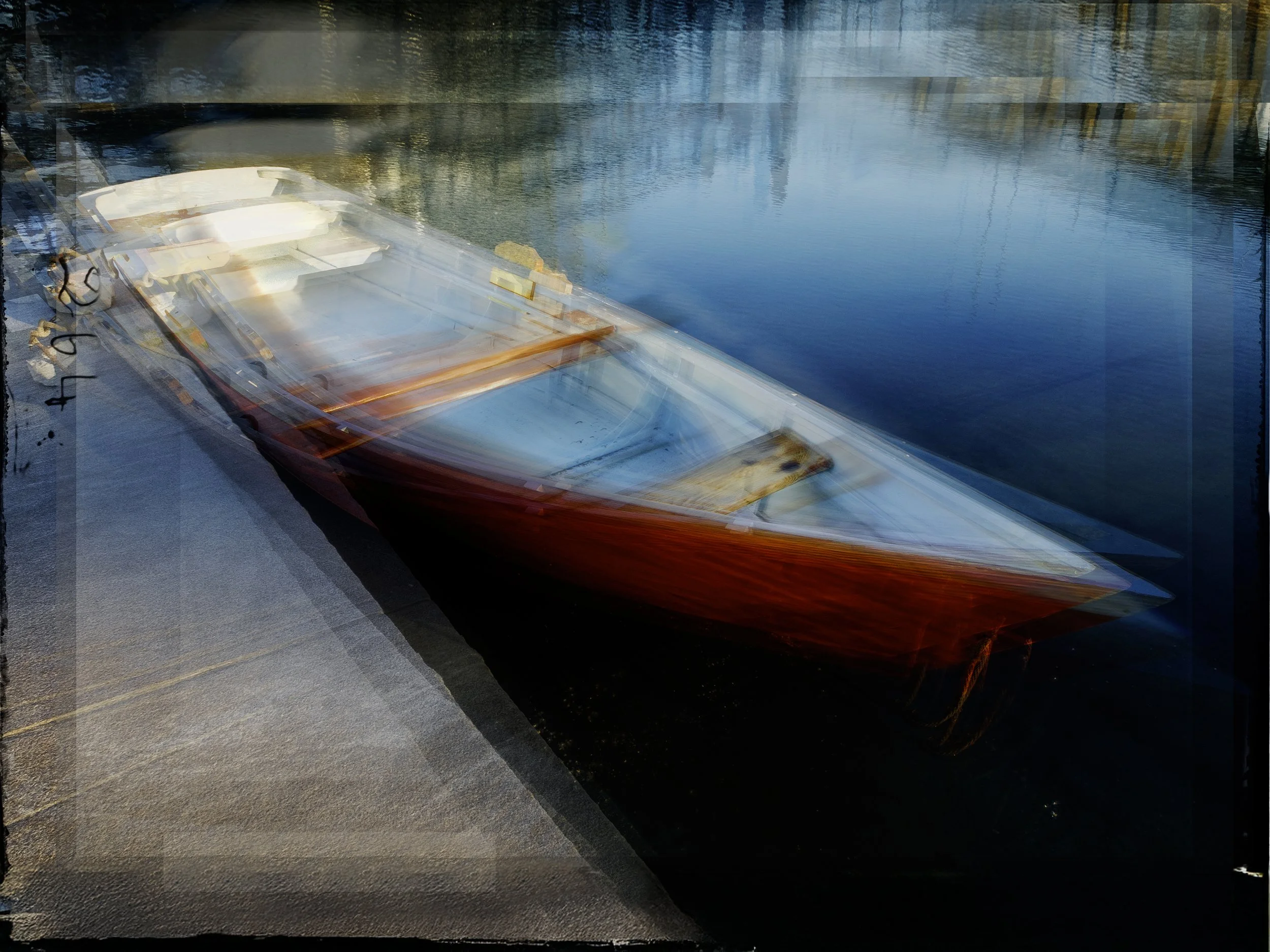
Walter Sickert, a British painter who was known as much for his obsession with Jack the Ripper as he was for his transitional work at the turn of the last century, once said “There is no such thing modern art, there is no such thing as ancient art- history is one unbroken stream.” And that makes sense for a person coming of artistic age in an age between ages. And it explains my art to me better than anything else ever could. Because ‘coming of age’ is a more accurate description of how I feel about my art than ‘emerging’. Everything I’ve made in the last fifteen months is a direct outgrowth of everything I did the previous 12 months, and so on and so forth. But the work I’m making now, and I am trying to avoid calling them photographs simply because they go beyond that general classification, is physically and conceptually different than anything I’ve ever made before.
Back before video killed the radio star, before digital photography killed film photography, photography itself was heralded as the end of painting. But it didn’t kill it. It changed it. Painting changed. It adopted a new sensibility, a photographic sensibility. Photographic composition is, in a gross generality, looser and more chaotic than painting. In photographs, things move in and out of the frame. In the beginning exposures were long- seconds long- and that movement, the actual passage of time, was recorded on that film. Think of what a powerful metaphor that was. Capturing the passage of time. Painters weren’t quick to attempt to replicate that, as what is plausible on film is not necessarily plausible on canvas. But painters did begin to frame their paintings differently, more chaotically. This was the permission that photography gave them.
Edgar Degas’ “L’Absinthe” (The Absinthe Drinkers) is a perfect example of a painted photograph. Deemed crude and ugly by critics of the time it is a photographer’s painting. A couple sits in a café, drinking absinthe. But the couple occupies not the center of the frame but the upper right quadrant. At the center of the painting is a break between two tables, the woman’s skirt peeking through the gap, her shoes partially obscured by the edge of another. Her companion to her side is, implausibly, being pushed out of the frame to our right. You could re-crop the image to the upper right and have a better composition. And a photographer likely would have done just that. But Degas didn’t. It’s an unedited, first person view, the way a camera sees a scene. Without romance and with observational objectivity. It’s one medium absorbing the sensibilities of another.
And that’s exactly how I feel about my ‘photographs’ and their place in time. They are photography-based, but they’re not photographs. I’d like to say they go ‘beyond’ but that’s just- I don’t know. They are prints in the technical sense, but they are also unique artifacts and not repeatable. They include painterly architecture, but not necessarily painterly iconography. Like motion on film, they are a metaphor for the passage of time, and the inconsistencies of memory. They’re- again I don’t know- part of an age between ages. They’re post-digital. They’re- just different.
And at this juncture, just different is good…